Writer. painter. Visual storyteller

Detective Scallion
A detective who escaped the kitchen to investigate the world.

Detective Scallion
Detective Scallion was not always a detective.
Once, he belonged to a kitchen — a place filled with noise, repetition, and quiet decay. One day, without announcement or farewell, he left.
Since then, he has wandered beyond cutting boards and boiling pots, investigating the strange habits of the world and the fragile logic of human lives.
He solves no ordinary crimes.
His cases are made of silences, misunderstandings, forgotten dreams, and truths people carefully avoid seeing.
Each episode follows a seemingly small mystery — yet beneath it lies a question:
what does it mean to live consciously in a world that rarely pauses to think?
New episodes arrive every Thursday.
Episode one
Sometimes stories don’t begin with heroes —
they begin with a quiet departure.

The story began on a damp, rain-soaked night.
He stood by the window; nothing could be seen outside. The glass reflected mostly his own image, and a vague unrest breathing somewhere behind him.
For the last time, he looked at the photograph in his hand.
A half-alive smile. A cold, trembling light. A hidden anxiety — and a shadow that did not belong there.
He drew deeply on the cigarette at the corner of his lips. Smoke rose, yet the burning in his eyes did not fade; some tears have nothing to do with smoke.
Slowly, he walked toward the candleholder and carefully surrendered the edge of the photograph to the flame, making sure the fire would burn only the picture and its memories, not him. The flame was small, but he knew well how small things could reduce entire worlds to ash.
He watched it burn for a while. No haste. No hesitation.
His gaze wandered across the room as he took a deep breath.
He was tired of this place.
Of the endless grumbling of the fat kettle that had done nothing but sit on the fire.
Of the refrigerator’s murmur — a lawless club hiding the last pleasures before consumption, wearing a false innocence whenever its light came on.
Of the green, sprouting potatoes driven nearly mad, shouting at dull knives.
Of the rotten leftovers — like the cheese that was never chosen, its smell still wandering through the air.
And of the newly arrived, celebrated knives that made everything destined to be eaten tremble.
Suddenly, the refrigerator light flicked on.
He looked away.
His hand moved instinctively to his pocket — where the photograph no longer existed.
He inhaled deeply. This was no longer just a kitchen. Something in the air had decayed — something beyond food.
He extinguished the cigarette.
He was not a young scallion anymore: tall and green, with eyes permanently moist — no one knew whether by nature or by memory. The sharpness of his being hid quietly behind smoke, as if he wished to be felt less himself.
A faint metallic sound echoed from afar — something dragging across a cold surface.
A pale smile appeared.
He had found the answer — and that was the most dangerous part.
He was no longer looking for justice here.
The scent of wet soil slipped in from beneath the door, a smell long absent from this kitchen.
He picked up his coat.
For the last time, he did not look back.
In a rough voice, like a late-night podcast, he murmured:
“Some truths cannot survive beneath the light of a kitchen lamp.
They need soil.”
He stepped toward the door.
Perhaps, from now on, he should be called Detective Scallion.
Silence Always Smells Like Wet Soil
Episode two


“No crimes are found in this kind of silence.”
He stepped into the garden and closed the door behind him. He walked a little farther, then stopped.
Dusk had only just fallen asleep, and the night had taken a deep breath.
A vast, living silence surrounded him; not the kind of silence that is empty — the kind that has ears and listens to the depths of your being.
The soil beneath his feet was damp. The scent of fresh rain rose patiently from the heart of the earth; a scent like the embrace of a mother who had once carried him within herself.
The burning in his eyes had softened a little. He dropped the cigarette and pressed it into the soil with the tip of his shoe.
He looked around. Perhaps someone in the garden was still awake.
A little farther away, the movement of a leaf caught his attention. He stepped forward quietly, moved the leaf aside with one hand, and lit a lighter with the other.
In the darkness around him, that small flame was enough to illuminate the path of his gaze.
A mushroom sat peacefully among the sleeping plants; a silence that, in all its simplicity, seemed to be hiding a storm.
Could decay also be found within such freshness of soil?
He stepped closer and stared at the mushroom for a while. Under his breath, he said:
— Do mushrooms need meditation too?
The mushroom stirred in the light, opened its eyes, and said:
— Detective… no crimes are found in this kind of silence.
It paused for a moment, then continued:
— Though you are not quite as far from the modern world as you think. But don’t worry… perhaps you are safe here. Cold, sharpened metals have no place in the dampness of soil.
He was Detective Scallion, not some delusional scallion. The mushroom’s words did not surprise him. Perhaps the mushroom had guessed the story from his long coat or the sweat resting on his forehead.
He was a detective with a logic of his own.
Even so, a thought crossed his mind:
Was he considered a stranger to the garden?
Or had the garden been waiting for him all along?
The mushroom’s humble home, roofed only by the sky, contained nothing but a single couch. Its grass-like walls shifted even before the wind arrived — yet it was still a home, enough to shelter a weary detective.
Perhaps the detective no longer feared a hidden killer. Now he was searching for a meaning he had only recently discovered — perhaps freedom, or simply fresh air to breathe.
The mushroom had no intention of sleeping yet. A quiet anticipation rested deep within him, so he invited the detective to rest on his couch.
Minds crowded with unrest rarely find answers. More than anything, Detective Scallion wished, like the mushroom, to offer himself a moment of peace.
So he accepted the invitation.
As he approached the couch, a magazine lying upon it caught his attention.
With bitterness in his voice, he asked:
— I didn’t take you for someone interested in the world of fashion.
A gentle smile appeared on the mushroom’s face.
— It’s the only photograph I have of my beloved. The warmth of her kiss still lingers… though now she stands in someone else’s embrace.
Scallion looked at him in surprise.
— That woman? How long was she with you?
The mushroom answered softly:
— She held me close for a moment… no longer than a kiss — yet those few minutes were enough for me to memorize every line upon her body. Each of us carries lines of soil on our skin.
The detective took a deep breath, shook his head, and silently pitied the mushroom for his imagined love.
The mushroom said nothing more and retreated into his silence.
Earlier, the detective had thought of the mushroom as a creature of wisdom. But maybe awareness does not always come through perfection. Sometimes a wound born from foolishness becomes a lantern along the way.
With a bitter smile, he said quietly:
— Is there really any difference between thinkers?
Then he removed his coat and stretched out upon the couch.
What had happened in the kitchen to wound him this deeply?
Lost in those thoughts, his eyelids slowly grew heavy, and he drifted into sleep.
Silence became their host.
Silence always smells like wet soil…
A short while later, he awoke to the sound of a scream.
He rushed frantically toward the mushroom.
The mushroom’s lifeless body lay on the ground.
And the owner of that feminine scream was no longer there.
Only the trace of her perfume remained behind.
It did not take long for him to realize that the dampness of the garden no longer felt unfamiliar to him.
He lit a cigarette.
Truth Rarely Survives Desire.

A Cold Thought, Sipped Slowly from the Depths of Soil

Episode three
It did not take long for the homicide police to arrive, stealing the silence and darkness of the night like thieves.
Wasn’t the detective the only witness at the scene?
Who had informed them?
Perhaps, in the safety of the garden, crime is a silent scream that somehow reaches everyone.
The sound of sirens and the spinning red-and-blue lights painted the wet grass in unfamiliar colors.
With furrowed brows, the detective fixed his eyes on Doctor Asparagus — a figure whose calmness had quietly captured his attention.
Asparagus was thin yet tall, with a resolute face. Cold and detached, he seemed like one of those who had spent so long beside death that it no longer felt like an event.
He removed the mushroom from the crime scene with unsettling ease, as though his only concern was that the mushroom might suddenly wake up.
Within moments, he declared everything finished — an ending for the mushroom as effortless as switching off a bedside lamp.
Perhaps the embrace of soil is the final, unavoidable bed awaiting all who belong to the garden.
Scallion took a few steps toward Asparagus and said sharply:
— If you looked more carefully, perhaps you’d find a trace of the killer.
Only a few seconds of silence followed.
Asparagus could not conceal his irritation. He raised a clenched fist toward the detective and snapped:
— And who are you to tell me how to do my job?
He was right.
Who was he?
Detective Scallion was nothing more than a newcomer. He was not even wearing his coat.
Sometimes the clothes you wear buy you respect before anyone has the chance to judge you.
But how was he supposed to put on his coat quickly enough?
Perhaps a detective ought to sleep in it.
At that moment, Asparagus turned his head toward the couch — toward the coat hanging beside it. He drew a deep breath and slowly shook his head.
So clearly that even the detective could hear the sound of his thoughts.
A man whose only souvenir from the modern, corrupted world was disorder — or perhaps disorder was a creature that found its owner even in the middle of peace.
This time Asparagus spoke more calmly:
— Wouldn’t it be better to stop something before it happens? If you were in his place… would you care what happened after you were gone?
Even silence had no answer for that question.
So their brief conversation ended there.
The sounds faded.
The lights disappeared.
And another scene came to an end.
Once they had gone, the garden fell quiet again. The darkness of night became the detective’s host once more.
The detective was left with only a couch — a small inheritance from the garden’s generosity.
At least now he had somewhere to rest the weight of his exhaustion and his thoughts until morning.
Lying on the couch, he placed a cigarette between his lips. He closed his eyes and took a long drag.
Suddenly, he remembered the disappearance of the young carrot — right after entering that suspicious colander.
He sank deeper into the couch, almost as though it were a bathtub in which he wished to drown his head and cool the fever of his thoughts.
Truths that were never uncovered, hidden behind secret meetings between veteran parsleys and inexperienced tarragons in the darkness of the refrigerator.
Had those filthy conspiracies, lost beneath the glitter of the modern kitchen, somehow found their way into the garden?
By the time his thoughts came to an end, the night had ended too.
He rose to his feet.
This time, he needed to arrive at the scene before it was too late.
Daylight had given him a clearer view.
Not far away stood a house atop a hill — a house that surely knew something about last night’s commotion.
He made his way toward it.
The sound of the doorbell echoed through the quiet morning beneath the pressure of his finger.
Mr. Potato, the owner of the house, welcomed him without resistance and invited him into the sitting room — a room with large windows overlooking the events of the previous night, where perhaps the only obstacle to the truth had been the darkness itself.
Mr. Potato sat across from the detective on the couch.
At first glance he appeared indifferent, yet the heaviness of his body sinking deep into the cushions suggested something else entirely.
From his relaxed appearance, it seemed he had nothing to hide.
His thoughts, much like his body, sat naked before the detective, slipping slowly from his mouth one after another.
The narrow teacup looked far too delicate between his large, untrimmed fingers.
He lifted it with a grace that bore no resemblance to the roughness of his nature.
He tasted the tea not as a simple drink, but like an expensive wine — a noble attempt to conceal something coarse that still clung to him from the depths of the soil.
He took a sip and said:
— From the scent of her perfume, it was obvious she had come to see the mushroom… but why? Why the mushroom?
At those words, the detective remembered the fragrance once again.
It was true. The perfume had been strong and seductive enough to pull a man from his seat and lure him toward the window.
Mr. Potato’s gaze remained fixed on the glass. The teacup trembled faintly between his fingers.
Perhaps he was imagining the woman’s face somewhere deep inside the story.
He took another sip and said quietly:
— Perhaps every man would want to have her.
The scent of jealousy wandered through the room.
The garden was full of men who spoke heavily of reason and logic. Yet all it took was for a beautiful woman to enter the room for the jealous little boys hiding behind those grand words to awaken.
And finally, after the last sip of his tea, he let out the last fragments of his thoughts:
— Sometimes I almost feel sorry for him… Broccoli has been entering scenes quietly these days. Environmentally friendly vehicles… perhaps they don’t even leave wheel tracks behind in the soil.
A cold sweat gathered on the detective’s forehead.
Painfully, he swallowed the lump in his throat.
A mistaken judgment had blinded him to the truth.
To repeat the same mistake and arrive at the same ending once again — what punishment could there be besides pain?
His cigarette had burned to its end.
A small flame scorched the tips of his fingers, yet the burning in his eyes remained.
Perhaps careless judgments are an ordinary habit for ordinary people… but what about for someone who seeks the truth?
He needed fresh air.
He crushed the dead cigarette into the ashtray with more force than necessary.
Then he stood up.
Unlike Mr. Potato, who remained lost inside his own thoughts, the detective felt as though someone was waiting for him behind the wall.
Walls that possessed not only ears, but tongues made for building rumors.
Ignoring the potato, he stepped out of the room.
And there, standing before him, was a woman
The Mad Bird That Dreamed of Flight
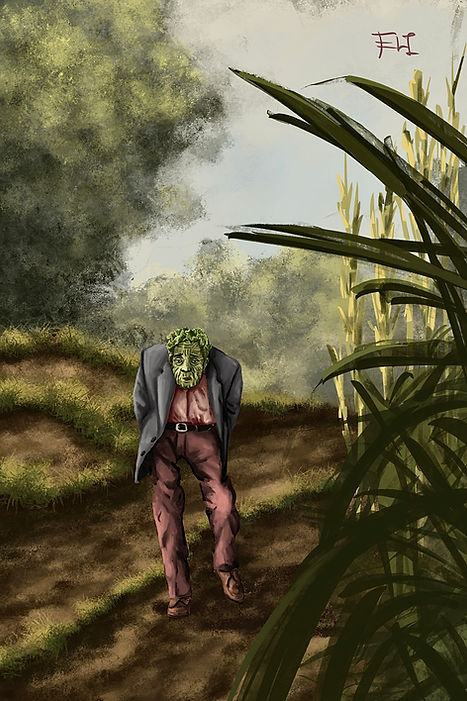
Episode four

Truth Often Wears the Face of Envy.
Mrs. Potato stood before the detective.
Yes, those rumor-loving ears belonged to Mrs. Potato. A tall, broad woman with swollen skin, as though the world’s news flowed beneath it. Her narrowed eyes missed nothing. She watched everything carefully, making certain Mr. Potato would never discover she had spoken with Detective Scallion.
There was no time for introductions.
She went straight to the point.
In a quiet voice, though with remarkable urgency, she said:
“Do you know? Some women walk into a room and every man forgets who he used to be.”
She paused.
For a moment, it seemed even she wasn’t sure whether her anger belonged to the woman—or to the men who had fallen under her spell.
Her gaze drifted toward the ground.
Then she lifted her head again.
“She’s one of those women,” she continued. “The kind who deceives everyone and somehow manages to earn their sympathy as well.”
She drew a deep breath, as though trying to cool a heat rising from somewhere deep inside her.
Her voice softened.
“Mr. Broccoli… a respectable man. A handsome one, too. He fell for her as well. Last night, I warned him that White Radish was here. I thought perhaps he would finally see her for what she is. But it seemed he already knew. And still, he rushed to her side. Still, he wrapped his arms around her and saved her.”
Throughout her speech, the detective simply watched.
He studied every detail of her face.
The widened eyes.
The avalanche of words spilling from her mouth before thought had the chance to catch them.
Was it jealousy of the woman’s life?
Or jealousy of the way Mr. Potato looked at her?
Compassion certainly had nothing to do with it.
Perhaps Mr. Broccoli occupied a corner of her mind as well.
When she finished, she squeezed the detective’s hand with her rough fingers and thanked him for coming.
She hoped her words would help uncover the truth.
And, of course, that White Radish would finally receive what she deserved.
Were Mrs. Potato’s words useful?
Very rarely do people help in the way you need.
Most help in the way they believe they should.
Until now, Detective Scallion had mostly listened.
To judge well, one needs large ears long before a sharp tongue.
He returned to the crime scene.
They say killers return to the scene of the crime.
But why Detective Scallion?
He examined the wheel tracks carefully. After the chaos of the previous night, identifying one unusual set of tracks among many was perhaps beyond even his expertise.
His eyes drifted toward the magazine cover.
Was the woman guilty?
Then something else caught his attention.
A business card.
It had been left on top of the magazine.
He picked it up.
The edges were still clean.
It wasn’t wet.
It hadn’t been stepped on.
It looked as though someone had deliberately left it there to be found.
Dr. Asparagus.
A name that had seemed far too calm since the previous night.
Other than a fading outline of chalk, was there anything left behind from the victim’s final meeting with the soil?
In this so-called home—this inheritance from the garden—who would need Dr. Asparagus’s card?
Did a forensic doctor really need business cards?
Perhaps killers and detectives were expected to know him.
Perhaps even to find him.
He slipped the card into his pocket.
Then he followed the dirt road, searching for wheel tracks that might lead him closer to the truth.
The first person he wished to find was White Radish.
Questions circled endlessly through his mind.
He spent several minutes walking with those thoughts until a sound pulled him from them.
Footsteps.
Not the footsteps of strength.
The footsteps of someone whose weakness had refused to surrender.
From between the bushes emerged an old lettuce, bent with age, mumbling fragments of thought as he slowly approached.
His words carried a sharp scent.
Bitter.
The scent of truth.
The old lettuce raised his head and looked at the detective with tired eyes.
One of his dried leaves trembled as he spoke.
Not from the cold.
From the exhaustion of years spent speaking to those who never listened.
He raised his voice slightly.
“A plague born of madness has poisoned the garden. The altered vegetables can no longer bear fruit. Seeds removed in the name of comfort. The pursuit of power is an eternal curse among vegetables.”
He paused.
Then added:
“We are not alone…”
He lowered his head once more and continued past the detective, his eyes fixed on the ground.
The detective watched him carefully.
Sharp eyes were part of a detective’s trade.
The old lettuce’s trembling hands revealed a pain that had settled deep among the wrinkles of his leaves.
Then the rain began.
Not violently.
Not angrily.
Only soft and silent.
It barely touched the detective’s coat.
More like a gentle hand upon the garden’s broken heart.
Perhaps one day it would become fertile again.
As the old lettuce slowly walked away, he began to sing.
Perhaps he wanted the detective to stand there and follow him with his eyes until he vanished from sight.
In a trembling voice, he sang:
I saw a bird crying out.
I want to be a bird.
I want to fly.
I want to fly across the sky.
But what if I grow tired and return to the ground?
What if danger is waiting for me there?
I want to leap from this cage.
But what if no one is waiting for my return?
Ah, that foolish bird…
What if one day it truly escapes?
As he sang, he drifted farther and farther away.
Until neither his voice nor his footprints remained.
The detective did not know whether he pitied the bird—or the old man who still dreamed of flight.
Perhaps they were the same thing.
He continued walking until he reached the city.
The noise and movement of urban life swallowed him as he continued his search for White Radish’s home.
A quiet street lined with rows of trees led directly to it.
He moved forward.
A large window.
And a first glance.
There she was.
Standing beside the glass.
Silence overtook him completely.
Now his ears were filled only with the sound of rain, and his body carried its dampness.
Life paused for a moment.
The detective breathed again.
He hid the cold sweat upon his brow inside the rain.
Straightened the edge of his coat.
And stepped toward the door.
Some cases begin with a corpse.
Others begin with a glance.
A Truth Made of Feeling.

Episode five
Power exists beyond duty and beyond law.
The door opened, and a servant welcomed him inside.
Detective Scallion walked quietly through the silence of the house toward the room where Turnip was waiting.
Long before the sound of his footsteps could echo through the halls, she had already experienced his presence countless times in her dreams.
The waiting was over.
Scallion stepped into the room.
Miss White Turnip was no flawless angel, yet that single look was enough to stop him where he stood and make him feel the beat of his frozen heart once again.
Had her beauty stolen the detective’s gaze?
Or was he feeling something for which he had not yet found a name?
The burning in his eyes had grown worse. He moved toward the window, hoping the damp air of the street might somehow find its way through the closed glass and ease the pain.
Turnip slowly approached him.
Perhaps a little closer than was customary.
But Detective Scallion was no stranger to her.
Her eyes remained fixed on his, as though she were searching for a truth hidden somewhere within the restless sea of his gaze.
A faint smile touched her lips.
“Detective Scallion… is it really you?”
Scallion concealed his softness behind furrowed brows.
He had to play his role well.
He was a detective, not bait for the hook of love.
He refused to give his feelings any power.
Taking a step back, he spoke firmly.
“You were expecting me? Then you already know that you may be the reason Mushroom is dead.”
The air in the room seemed to grow heavier.
As though even breathing required courage.
The color drained from Turnip’s face.
Her legs weakened, and tears gathered in her eyes.
“Mushroom is dead?”
The excitement and anticipation she had carried only moments before shattered within her voice.
Silence settled between them.
Only the hands of the rain continued knocking against the window.
A faint tremor had found its way into her fingers.
She turned her gaze toward the glass and spoke softly.
“He was not an ordinary mushroom.
“He saw things before their time had come.”
This time, Scallion’s voice softened.
“When did you see him last?”
Turnip drew a deep breath.
“He always wrote letters to me.”
A faint smile appeared upon her lips.
“The strangest letters I had ever read.
“He said he understood my confusion.
“He said every person carries a voice they can never truly hear themselves.”
She looked back at the detective and fell silent for several seconds.
Then she continued.
“One day he wrote to me about love.
“He asked me to come see him. There was something he wanted to tell me.
“But Broccoli arrived.
“He is a shadow whose cold presence I have always felt.
“To hide Mushroom’s unfinished words, I kissed him. I wanted to conceal the truth from Broccoli.
“But something else remained behind.”
She lowered her eyes.
“I thought it was only a performance.
“But perhaps some people take performances more seriously than life itself.”
Detective Scallion remembered Mushroom.
How had something so simple left such warmth inside his heart?
Sometimes a single kiss creates stories that continue living in the mind for years.
Turnip continued.
“He wrote to me again.
“He said he wanted to show me what love truly was.
“I went to meet him that night, but Broccoli was already there.
“Before I had any chance to refuse, he forced me into his car.
“Even my screams brought no one to help.”
She paused.
A frozen breath escaped her lips.
“I never imagined jealousy could demand a life as its price.”
Scallion and Turnip stood before the window.
And the rain was not the only witness to their meeting.
Unaware of his surroundings, unaware even of the headlights of a car quietly approaching the house, the detective kept his eyes fixed upon her.
Were the tears in Miss Turnip’s eyes speaking the truth?
Or was there a lie hidden beneath the mask of innocence?
Detective Scallion finally looked away.
Detectives are accustomed to reading others, not being read themselves.
Yet he could not shake the feeling that Turnip was reading something inside him.
Without taking her eyes off him, she remembered Mushroom’s words.
Then she stepped closer.
And kissed him.
Not lightly.
Not theatrically.
But from the deepest part of herself.
For a moment, the detective was powerless.
Something heavy settled inside his chest.
He had been searching for witnesses.
For evidence.
Not for a feeling that could never be entered into any case file.
He pushed her away.
“So this is how you play with people?”
Turnip swallowed the ache in her throat.
“No…
“It’s not like that.
“Didn’t you feel anything?”
Scallion remained silent.
Some questions cannot be answered with words.
Especially when you fear the answer yourself.
Turnip never looked away.
In a broken voice, she continued.
“Don’t you remember me?”
Slowly, she raised her hand toward his tear-filled eyes.
Her fingertips brushed his face.
“Have these eyes always been filled with tears for no reason?”
There is an old legend.
It says that at the moment of birth, one catches a glimpse of death.
Yet throughout life, only a rare few ever remember what they saw.
Was there a bitter truth hidden within that loving kiss?
As Turnip spoke, the detective sensed someone’s presence.
Immediately, he pressed a finger against her lips to stop her from saying more.
But he was too late.
Whoever was there had already heard everything that mattered.
The silent driver who had approached the house earlier.
The one whose headlights had illuminated them through the window without the detective noticing.
He departed just as quietly as he had arrived.
Scallion moved to follow.
But Turnip caught his hand.
Perhaps she wished to protect him.
Or perhaps it was a selfish attempt to claim her share of life before it slipped away.
That brief hesitation was enough.
The detective lost his suspect.
All he could do was watch a car disappearing into the distance.
He pulled his hand free.
“We shape our own destinies through our choices, not through anything else.
“And because of you, I’ve lost my suspect.”
Turnip slowly turned toward the window.
Her back facing him.
“Some things exist beyond choice.”
She paused briefly, then continued.
“Don’t worry.
“You’ll find him at the city’s largest—and only—cabaret club.
“Broccoli will be there.
“But you should be careful.
“Then again, you’re a detective…
“Perhaps no danger would dare come near you.”
Detective Scallion remained by the window for several moments.
His mind was crowded with voices, questions, and fragments of unfinished thoughts. There was no room left to hear the sound of his own heart.
Ignoring Turnip—and the feelings she had awakened within him—he left the house and set out to find Broccoli.
The silence of the streets moved beside him.
Only a few minutes had passed before a conversation caught his attention.
An elderly man and woman stood together, watching him with eyes full of judgment.
Their whispers were hidden behind raised hands, yet the bitterness within them was impossible to conceal.
“Broccoli must have seen them together.
“Poor man.”
“The moon never stays hidden behind clouds forever.
“The guilty are always exposed in the end.”
Why did so many people harbor such hatred toward a woman?
What bitter truth lay hidden within Turnip’s life?
The rain had weakened, but it had not stopped.
It was not a day for standing still.
So the detective continued on toward the city’s only cabaret club.
Before long, a grand and elegant building emerged before him.
Huge posters of the city’s beloved singer covered its walls.
And parked directly in front of it stood the same black car he had seen through Turnip’s window.
Now it was easier to understand why so many women in town disliked her.
Perhaps it was because every evening men came here to hear her voice.
Or perhaps simply to look at her.
The doors of the cabaret stood open.
There were still hours left before nightfall, and the venue had not yet awakened for the evening crowd.
Scallion stepped inside.
As a detective, it was not difficult for him to move quietly through the building and make his way to Broccoli’s office.
Broccoli was a well-known figure in the city.
And, as it happened, the cabaret belonged to him.
The office door stood partially open.
Fragments of conversation drifted into the hallway.
Scallion carefully peered through the narrow opening to make sure he had found the right man.
He had.
Broccoli sat beside his lover.
Taking a slow sip of whiskey, he said:
“You know she isn’t the woman I would have chosen.
“She’s cold.
“Empty.
“But she’s the woman everyone wants.
“So she belongs beside me.
“Lately she’s become defiant.
“Perhaps I have a suitable answer waiting for her.”
Scallion hesitated.
Then quietly stepped backward, intending to leave the cabaret.
But just as he turned away, a hand settled gently upon his rain-soaked shoulder.
A voice spoke behind him.
“Were you looking for me?”
Scallion turned.
Broccoli stood before him.
The detective glanced at the bitter smile resting upon the man’s lips.
Then he looked down at his own wet clothes and the droplets of water that had left a trail impossible to hide.
Should a detective leave tracks behind like careless prey?
Broccoli introduced himself.
Assuming Scallion was merely a newcomer to the city, he invited him to that evening’s gathering at the cabaret.
Even if he had no desire to attend, Scallion could not ignore such an opportunity.
Truth has a habit of finding its way out through someone’s mouth when enough people gather in one place.
So he accepted the invitation and left.
After he was gone, a sly smile spread across Broccoli’s face.
His lover stepped closer.
“Wasn’t he standing outside the door?
“Didn’t he hear everything we said?
“Then why invite him?”
Broccoli smiled.
Through the window, he watched the detective disappear into the damp streets.
There was pride in his voice when he answered.
“That man wears the coat of a detective.
“And little else.”
He took another sip of his drink.
“I think it’s time someone showed him exactly where he stands.”
The rain had finally stopped.
Yet Detective Scallion still walked through the streets carrying traces of it upon him.
He slipped a hand into his pocket.
Dr. Asparagus’s business card was still there.
Sometimes people leave signs of themselves behind long before they ever speak.
How Quietly Power Steps Onto the Stage
Episode six


Street Legends and Baseless Rumors
He spun the card between his fingers and continued on his way, but something in the middle of the street brought his steps to a halt.
Beautiful women.
Or rather, what remained of them.
Their faces now survived only as images printed on paper. Above each portrait, in large bold letters, a single word could be read:
MISSING
The posters had been pasted across a cold stone wall.
Directly opposite that wall lay what looked, at first glance, like an old fallen branch from a cherry tree.
But a closer look revealed something else.
A cluster of old, wrinkled cherries, gathered together in conversation.
Were they rusted minds with mouths forever open, weaving endless rumors?
Most passersby would probably see nothing more than a group of elderly gossips filling their afternoons with meaningless chatter—judging others while trying to fill the empty spaces left behind by their own abandoned dreams.
But the detective saw something different.
Something others missed.
A deep and ancient fear hiding behind their watchful eyes.
They had disguised their secret gathering remarkably well beneath the noise of the city.
Scallion considered approaching them, then paused.
A detective might wear a coat, but a detective soaked from the rain was hardly a convincing source of authority.
So he tied the invisible clue to the corner of his memory and promised himself he would return.
The card spun once more between his fingers as he continued down the street.
Finding Asparagus was not difficult.
Some people even print their address on their business cards—as though they are afraid of giving the world an excuse not to find them.
His building was old.
Faded white paint peeled from its walls.
Cold.
Lifeless.
Much like the clothes Asparagus always wore.
Perhaps few people entered that place willingly.
Or perhaps people only arrived there once the world had already lost its color.
Scallion turned the aged brass handle and stepped inside.
From behind his desk, Asparagus examined him from head to toe.
The detective was still damp from the rain.
Curiously, Asparagus did not seem surprised to see him.
If anything, he looked slightly disappointed.
As though he had expected him sooner.
Scallion studied the expression on his face.
He cleared his throat, attempting to look more authoritative.
“I’m not here to interrogate you.”
He reached into his coat and produced the business card.
“I think you’re the one who wants to talk to me.”
It was probably not the first clumsy thing the detective had done.
Asparagus fell silent.
His eyes moved from the card to Scallion’s face.
A trace of color warmed his cheeks.
A small fire of irritation, perhaps.
He drew a long breath.
“Do you know what your problem is, Detective?”
“You always assume the truth is standing somewhere waiting to be found.”
“Sometimes the truth hides from you.”
Then he continued, his tone edged with reproach.
“With all the theories running through your head, you still wandered around half the city before coming here.”
“Tell me, do you really think you’re the right person to uncover the truth?”
“Or are you going to lose yourself in the darkness as well?”
Scallion frowned.
Before he could answer, Asparagus continued.
“Regardless, I saw how restless your mind was that night.”
“I thought I might help.”
“Some time ago, I received a letter from Mushroom.”
“To be honest, I don’t believe this was a murder.”
“Perhaps it was simply the collapse of a troubled mind that finally chose to end its own life.”
He opened a drawer and handed over an envelope.
Scallion examined it.
A clean white envelope.
Not so new that it had never been opened.
Not so worn that it had passed through countless hands.
It looked as though someone had read it only once—and without much attention.
He opened it and glanced through the contents.
A faintly mocking smile appeared on his face.
“I doubt even Mushroom’s spirit would recognize this letter.”
He paused.
“There was no despair in him when he died.”
“Only peace.”
His voice softened.
“Who informed you?”
“What part did Broccoli and Turnip play in all of this?”
Something changed in Asparagus’s expression.
“Mushroom’s story is over.”
“Cucumber has already confirmed it.”
He sighed.
“This case will be closed unfinished.”
“The difference is that this time there is a victim…”
“…but no killer.”
They spent nearly an hour talking, and somewhere during that conversation, the detective had gained a friend—one willing to lend him something suitable to wear for that evening’s gathering.
But before the night’s event, there was somewhere he needed to go.
So he wasted none of the little time he had left and set off at once.
As he walked, Asparagus’ words lingered in his mind..
On the letter resting in his hand.
And on sentences he never would have imagined hearing from Mushroom:
Crimes are happening one after another.
This cycle repeats without end.
They speak of fire and the phoenix.
A pity that the phoenix belongs to a burned land—a place where pain never truly ends.
Sweet legends are lies whispered from one generation to the next so that people can keep living.
I want to put an end to this pain.
I want to break free from this broken cycle.
I am tired of the hands of power that move me like a piece in their game.
He continued turning the words over in his mind until he arrived at the largest building in the city—the place from which its laws were issued.
He pushed open the door and stepped inside.
The building was alive with noise.
Dozens of men filled the halls, their voices colliding into a constant roar.
Each argued so fiercely for his own interests that it seemed less like debate and more like a battlefield.
Only a few seconds had passed before a man approached him.
“Mr. Cucumber is expecting you in his office.”
The detective climbed the stairs and entered the room.
Who would have imagined that the same simple cucumber—whose most famous characteristic was an excess of moisture—would one day sit at the center of power?
Moisture that, at its best, should have brought nothing but softness.
Not ambition.
Yet Cucumber was there.
A lean, middle-aged man overflowing with confidence.
He sat comfortably upon his sofa, as though the room itself had been waiting alongside him.
But Scallion’s surprise reached its peak when he noticed the enormous portrait hanging in the center of the office.
Miss White Turnip.
Sometimes the truth cannot be seen, even with your own eyes.
Truths That Must Be Drunk Bitter
Episode seven


An Anxiety Hidden in the Heart of the Street
Cucumber was a perceptive man. The detective’s glance toward the portrait behind him did not escape his notice.
Without a moment’s hesitation, he said, “Women are the jewels of a society. Art draws its life from them.”
Then, in a calmer voice, he added, “But she is a gem meant to rest on one pedestal alone.”
The color of the detective’s gaze shifted. He looked more intently into Cucumber’s eyes and said, “Yes. I’ve seen her photograph on the cover of a magazine before. And tonight, I’ve been invited to her performance.”
Was this the beginning of an ordinary conversation, or a warning dressed in courtesy?
Cucumber paused for a moment. Perhaps he had not expected an invitation to be extended without his knowledge. Or perhaps he simply had no desire to see the detective cross that threshold again.
He was a seasoned politician, yet something almost childish had sharpened his tone.
“So a newly arrived detective must spend his night in a cabaret club to become acquainted with the city?” he said. “Wonderful. But Detective, you won’t find any suspicion here.”
He let his eyes drift once more toward Turnip’s portrait, then fixed them on Scallion again.
“The bitterness of honesty makes people cling to lies. But you’re a detective. You should drink your tea bitter if you want to understand the truth—not like a child whose eyes light up at the sight of a sweet.”
Scallion cut in before he could continue.
“Perhaps the truth is bitter,” he said, “but every living creature has the right, now and then, to place a small sugar cube beside its tea.”
A flare of anger flashed in Cucumber’s eyes. His brows drew together.
Perhaps this was exactly the answer the detective had been waiting for—that sudden glimpse of bitterness laid bare in the man before him.
Cucumber’s voice hardened.
“This is a normal society, with ordinary events and routine concerns. Didn’t that modern world you fled need a detective more than this city does?”
The room was large and lavish, yet there was no space left in it to breathe.
The sting in the detective’s eyes had cast a thick haze across his vision.
Was it an open threat, or merely a question?
Cucumber did not move so much as a foot.
“Mushroom was a delusional creature,” he said. “His thoughts had grown so disordered that he could no longer control them. Perhaps the letter you read is proof enough of that. So while you are in this city, enjoy its humidity. It may ease the burning in your eyes.”
Without thinking, the detective slipped a hand into his pocket and set an unlit cigarette at the corner of his mouth.
Had his eyes truly revealed so much to Cucumber so easily?
Cucumber was not an uninformed man. A satisfied smile settled on his lips.
“I believe our conversation has come to an end,” he said. “You’d better light that cigarette outside.”
If the detective had been a novice, perhaps he would have thrown another sentence into the fight. But not every battle needs to be won. Sometimes survival lies in retreat—in accepting the shape of defeat and stepping away before it swallows you whole.
For a brief moment, anxiety had made the road disappear inside his mind.
And sometimes a single silence, in the middle of fear, is enough to let power begin flowing through your veins again.
So without another word, he merely inclined his head in a gesture that resembled a silent farewell and left the room.
Scallion stepped out of the building with his thoughts in disarray and made his way toward Asparagus’s office.
The streets were slowly surrendering their noise to the setting sun, as though the city itself, after that bitter conversation, had nothing left to say.
He was still lost in thought when, in the hush of the evening street, the faint sound of footsteps caught his attention.
Had Cucumber set someone to watch him?
There it was again—the sound of broken, anxious breathing, keeping pace behind him.
He turned quickly.
It was Miss Carrot.
A young woman who had taken shelter in the detective’s shadow so she could cross the emptiness of the street in safety.
She used to walk this route with a friend—one who had vanished without a sound. Now all she wanted was to reach her family before anything could happen to her as well.
The detective said nothing, yet those few silent steps he took beside her were enough to give the anxiety of that street a clearer shape.
Another thread tied itself in his mind to the wall of missing women.
Silent disappearances.
No killer.
Not even a body left behind to mourn.
It was enough to strengthen his resolve to attend the evening invitation.
By the time he reached Asparagus’s building, the white, faded structure was waiting for him like an old thought that had never quite left.
Inside, in the heart of that pale building, a polished room and a suit far beyond anything he had expected were waiting for him.
Every person has a world no one else knows about—like a hidden room inside a house, where you have left behind the things you once loved and quietly closed the door behind them.
And there, a mirror stood waiting.
A mirror in which the sorrow in one’s eyes could not be hidden.
Perhaps the anxiety had begun in Cucumber’s office, reached him in the street, and now stood before him in the mirror—face to face, leaving him no room to deny it.
Truths That Must Be Drunk Bitter
Episode eight


Power Never Retreats.
Detective Scallion left Asparagus’s office and made his way toward the cabaret club to accept the invitation he had received.
He drew a long breath.
Even this garden had lost its old, familiar face.
Was progress nothing more than elegant clothes draped over the same ancient corruption?
A corruption that merely changed its appearance while continuing to steal the soul of a society.
Long thoughts have a way of shortening long roads.
Before he realized it, he had arrived.
He stepped inside the cabaret.
He no longer looked like a detective.
He was simply another newcomer, unknowingly drawing quiet glances toward himself.
He walked slowly.
An empty table caught his attention—not close enough to the stage to become part of it, yet not so distant that it felt detached.
The distance was perfect.
From there, he could see the beating heart of the cabaret.
It was White Radish.
Standing beneath the stage lights, she looked like a pearl compelling the darkness itself to retreat.
She wore an elegant gown, and her perfume seemed to reach the room before her voice did.
Yet above everything else, what filled the air was the quiet sorrow that had settled inside her singing.
Her eyes eventually found the detective as well.
Perhaps only for a few seconds.
But sometimes, a few seconds are enough to disturb the balance of an entire night.
That brief exchange transformed Cucumber’s cool composure into the heat of burning pepper.
As always, he occupied his private table.
Not close enough to touch her…
Yet never far enough to be deprived of her presence.
Tonight, however, someone had stepped beyond the invisible borders he believed belonged to him.
From the corner of his eye, Cucumber noticed the silent longing in the detective’s gaze and the sadness resting within White Radish’s.
Then, without speaking a single word, he turned that bitterness toward Broccoli.
Broccoli might have owned the cabaret…
But Cucumber’s eyes suggested that power is not always born from ownership.
Broccoli stood beside the bar.
A subtle smile rested on his lips—
the smile of a man who believed he had already seen the end of the game before it had even begun.
There was satisfaction in his eyes.
A satisfaction that had eluded him for a very long time.
No one knew what was passing through his mind.
Perhaps he believed that with a single move he had drawn two rivals onto a board whose rules only he understood.
Amid that silent battle, White Radish moved gently with the music.
Like the branch of a tree swaying beneath an autumn wind—
yielding to it without surrendering her dignity.
She was performing Danser Encore by Calogero.
It felt as though that song had spent years waiting for this very night.
Scallion listened.
Not merely to the melody…
But to whatever the music was awakening inside him.
Perhaps happiness has never hidden itself only inside life’s great moments.
Perhaps it sometimes lives inside a quiet evening…
A smile…
A piece of music…
Or the presence of someone we love.
If the end is the inevitable destination of every road…
Shouldn’t we drink life with everything we have before we arrive there?
And if accepting pain—even through tears—is the price of peace…
Could that acceptance itself become the very comfort we have spent our lives searching for?
No voice whispered those questions.
Yet Scallion heard every one of them with startling clarity.
It was as though someone sat somewhere deep inside him…
Someone who was not yet himself.
The music came to an end.
The final notes slowly dissolved into the silence of the cabaret.
The stage lights faded.
Applause filled the room.
White Radish bowed.
This time, her bow lingered just a little longer than usual.
Sometimes, the present already carries the scent of the future.
Then she quietly left the stage and disappeared behind the curtain.
The conversations of the guests, the clinking of glasses, and the soft music that replaced her voice soon restored the heartbeat of the cabaret.
Scallion placed both hands upon the edge of the table and began to rise.
His feet hesitated.
He wanted to follow her backstage.
But he was a few seconds too late.
Cucumber had already left his private table and was making his way toward White Radish’s dressing room.
Earlier that day, after seeing the large portrait of White Radish hanging in Cucumber’s office, Scallion had realized that Cucumber’s interest in her was far more than admiration.
Broccoli, as the owner of the cabaret, was expected to remain among his guests.
But Cucumber…
Why him?
It was another question whose answer refused to reveal itself.
The laughter echoing through the room blended with the weight of Broccoli’s gaze.
With every passing moment, the air around the detective seemed to grow heavier.
Just then, a young woman gently rested a hand upon his shoulder.
With a graceful smile, she said,
“Mr. Broccoli asked me to bring this drink to you.”
Scallion turned toward the bar.
Broccoli was still standing exactly where he had been.
Wearing the same calm smile.
A smile that smelled less of hospitality…
And more of expectation.
The detective took only a single sip.
One sip was enough.
He realized he no longer wished to belong to that room.
Perhaps the only difference between this cabaret and that old kitchen was the heavy perfume poured over the same familiar corruption—
a fragrance meant to conceal the smell of rotting vegetables.
Without meaning to, he remembered the refrigerator…
and its restless nights.
Tonight, he wasn’t even wearing his detective’s coat.
It felt as though the last reason he had to remain there had quietly been taken from him.
Or perhaps that drink had been Broccoli’s most polite way of showing him the exit.
There was no reason left to stay.
Without looking back toward the stage, Detective Scallion quietly walked out of the cabaret.
Outside, the lights, the music, and the laughter were gone.
The garden had concealed itself beneath the silence and darkness of the night.
Only the dampness left behind by the rain, and the wet earth clinging beneath his shoes, made every step away from White Radish—and every step toward the house he had inherited—a little more difficult.
Scallion walked slowly.
The silence of the streets echoed louder than all the music he had left behind.
The pale glow of the streetlights shattered across the rainwater, scattering countless reflections over the wet stones.
Then his eyes fell upon a puddle.
A silent mirror holding the image of a lonely streetlamp.
He stopped.
Then took a step back.
He looked into the water.
It was his own reflection…
Yet something about it felt unfamiliar.
An emotion that still had no name.
A coat that no longer belonged to him.
He drew a deep breath.
Reached into his pocket.
Took out a cigarette.
Lit it.
Then quietly released the smoke into the waiting night.
He did not go home.
Almost without realizing it, he changed direction.
He needed to see Asparagus again.
Perhaps he could still put back on the identity he had taken off only hours before.
He arrived at Asparagus’s building.
He rang the bell.
The door opened immediately.
One glance was enough.
Before Scallion spoke a single word, Asparagus already knew the answer.
That night, the detective had found neither the truth…
Nor even the certainty that he was still asking the right questions.
Without exchanging a single word, Asparagus took back his own clothes.
The detective’s coat settled once more upon Scallion’s shoulders.
Sometimes, before people discover the truth…
They must first rediscover themselves.
The detective stepped back outside.
Once again, he looked like the Scallion the city knew.
Yet something within him was no longer the same.
On his way home, his thoughts returned to White Radish.
To the sadness lingering in her eyes.
Was that sorrow merely the reflection of his own coldness toward her?
Or was another secret still hiding behind those eyes?
The thoughts were bitter…
Yet impossible to escape.
Much like the lingering taste of the cigarette still resting at the corner of his lips.
The street was empty.
Only the sound of his own footsteps accompanied him.
Then, in that silence, a long black luxury car slowly passed beside him.
Its darkened windows concealed whatever lay within, like curtains drawn across a secret.
Its polished body caught his reflection again and again, breaking it apart before piecing it back together.
The detective stopped.
For a moment, he watched only his own reflection.
The car drifted into the darkness…
Taking its secret with it.
The greatest sacrifices leave behind neither witnesses…
Nor confessions.
They simply pass quietly beside us…
Without our ever knowing who, that night, chose to surrender themselves…
And the dreams they carried…
So that someone they loved could remain in peace.
Episode nine
A Farewell Made of Silence


A Silence from the Depths of Night, Toward Truth
The music had ended.
Mrs. White Radish stood before the mirror in her dressing room, surrounded by the countless flowers she had received.
She searched for her smile in the mirror—a smile that perhaps had left her face long ago.
Suddenly, the door handle slowly turned, and an uninvited guest entered the room.
Not for a moment did she imagine it could be anyone other than Cucumber.
Even Broccoli, despite how close he was to her, would have knocked softly before entering, announcing his presence.
But Cucumber…
Cucumber had always entered her life without a sound.
He approached slowly and, in his usual gentle voice, spoke of Radish’s beauty.
But Radish, as always, took a step back and quietly thanked him.
This time, however, something was different.
Cucumber kept his smile, but the calmness in his voice had changed. He reached out and held her delicate wrist; not hard enough to hurt her, but firmly enough to leave no room for escape.
He pulled her slightly closer and said:
“Why don’t you try living a little more wisely?”
He paused for a moment.
“Why do you think you are still alive?”
For an instant, Radish’s eyes trembled.
Cucumber continued:
“Do you remember that letter? Those few lines that were meant to be your final words…”
His voice remained calm, but every word carried weight.
“I was the one who arrived that day. I was the one who brought you back.”
“But some words… even after their writer has been saved, can still change another life.”
He never took his eyes away from Radish.
“But that letter… it led to another ending.”
He took a short breath.
“Mushroom…”
He whispered his name.
“The same letter that was meant to end your story became the end of his.”
Radish lowered her gaze.
Cucumber stepped slightly closer.
“How long are you going to keep running away from me?”
He paused.
“Aren’t you tired of Broccoli’s protection? He was always beside you so that no one could get close to you… but it seems even that was not enough.”
He left the sentence unfinished.
For a few moments, silence settled between them.
Then he released Radish’s hand and turned toward the door.
As he walked away, he said softly:
“Perhaps Scallion too…”
Radish immediately interrupted him.
She stepped toward him, took his hand, and said:
“Please… don’t do anything to him.”
For the first time, her voice broke.
“He is only a detective. He has no feelings for me.”
Cucumber stopped.
For a moment, that familiar calm returned to his face.
Perhaps getting what one wants is the sweetest moment for some people…
Even if the price is something that can never be recovered.
He turned back toward her.
With the same gentle tone, he said:
“I only want to hear it from you…”
“That you have no feelings for him.”
Radish looked into Cucumber’s eyes for several moments.
There was something in his gaze she could not ignore; a cold certainty, like a door slowly closing.
There was no escape left.
Sometimes, the distance between protection and harm is no greater than a single choice.
And sometimes, what begins in the name of love slowly turns into possession.
Without exchanging another word, the two of them left the room.
The hallway of the cabaret club held a heavy silence compared to the noise of the hall; as if its walls had trapped the music behind them.
They walked beside each other, yet neither of them was truly walking with the other.
A few moments later, the exit door quietly closed behind them.
On the other side…
Broccoli watched Scallion leave, a quiet smile on his face, as he slowly turned the glass of whiskey between his fingers.
The young woman standing beside him stepped closer and whispered:
“Radish… left the cabaret with Cucumber.”
Broccoli did not take his eyes away from the door.
He only raised his glass slightly.
As if the final piece had fallen exactly where he had expected it to be.
A faint smile appeared at the corner of his lips.
He took a sip of whiskey.
Without saying a single word.
On the other side of the city…
A lonely detective walked through the streets.
The night seemed to breathe more quietly than ever.
At that moment, a long, black car passed silently beside him.
The polished surface of the vehicle, like a moving mirror, broke Scallion’s reflection into countless pieces…
and then formed it again.
For a moment, the detective looked at it;
as if he were trying to find himself among those shattered images.
But without stopping, he continued walking.
He did not know that behind those tinted windows, a pair of eyes followed him until the very last moment.
Mrs. White Radish, unseen, never took her eyes away from Scallion.
Not because she wanted to say something…
nor because she still held any hope.
She was only saying goodbye.
A silent farewell to a love that had never been given the chance to begin…
and was forced to end before it was even born.
The words of Mushroom, along with all the romantic tales he had told her, slowly began to fade.
A strange calm settled over Radish’s heart.
Now she was certain that Scallion had never given his heart to her.
Perhaps this truth was more comforting than a thousand false hopes.
She slowly sank into the warmth of the seat and closed her eyes.
She was no longer imagining the future…
She was seeing the ending of her story.
The car moved through the streets without stopping even once at a red light, leaving one road after another behind.
As if, tonight, every light in the city had turned green for Cucumber.
There was nothing standing in his way.
The streets slowly drifted away from the noise of the night, and the city revealed another face of itself; one rarely seen in the light of day.
Amid the silence of the streets, a distant and unclear song caught his attention.
He stopped.
The voice came closer.
Old Lettuce, with his bent figure and slow steps, was making his way back toward the city.
When he reached Scallion, he stopped for a moment.
He lifted his head slightly and looked at the detective.
He only shook his head; perhaps he was tired of speaking into the silence.
Then he continued on his way.
But this time, he raised his voice a little louder:
“Like someone who no longer has a voice left to cry for help…
He gave up the struggle.
He cast the broken ship of his heart into the restless sea of fate…
And disappeared without a sound.
Perhaps so that he could heal his own wounds…”
As he walked farther away, his voice slowly disappeared into the darkness of the street.
But Scallion was no longer listening to the song.
His eyes remained fixed on the footsteps of old Lettuce.
On his leaving…
On his fading away…
On how quietly some people pass through our lives, without us ever knowing what stories they carry with them.
He continued walking.
This city is strange…
Its entrances and exits are always equal.
At last, he reached the home he had inherited.
A single couch, embraced by the meadow.
Mushroom…
A victim with no killer.
Only that couch remained; a place that perhaps still held a hidden truth within it.
Scallion sat down.
But this time, it was not the kind of sitting that takes the weight of exhaustion away from the body.
This was a moment made of waiting.
Waiting for the answers that stood one after another behind the door, waiting for the detective to be ready to accept their truth.
Sometimes the answer is clear…
But one must first learn to believe it.
He lit a cigarette.
But not at the corner of his lips.
This time, the cigarette rested quietly in the ashtray, slowly burning.
He was not afraid of the burning in his eyes.
Perhaps, in the silence and solitude of the night, he wanted to set free the tears that had long been chained within his eyes.
The moon stood in the night sky like a shining pearl, wrapped in a veil of clouds.
A gentle breeze passed through the meadow, carrying the scent of flowers with it; a scent that brought back the memory of Radish, the one who had never left him alone, even for a moment.
He accepted that somewhere deep within his heart, a memory of Radish was still alive.
A memory he could not remember how it had been formed, yet it was so warm and full of tenderness that even thinking of it made his body burn with fever.
Could memories truly belong only to the past?
Who knows…
Perhaps there are those who have already seen the ending of their story once.
Somewhere else in the city…
The night was passing not in the simplicity of Mushroom’s home, but among the luxury, light, and colors of Cucumber’s residence.
Cucumber stood before a floor-to-ceiling window that held the entire city within its view, slowly drawing from the cigarette at the corner of his lips.
The satisfied smile resting on his face had only one meaning:
He had conquered a woman’s realm, not through war, but through a silence woven with surrender; a realm that had long been the deepest desire of the men of the city.
Somewhere else…
Asparagus rushed out of his home, heading toward the detective.
Episode ten
Smiles on Their Faces. Secrets in Their Hearts.


A Love That Ended Within Four Walls
For the first time, in the silence of the night, Detective Scallion allowed himself to listen to his own heart—to the truth of what he felt for White Radish.
Now it was time to gather the scattered pieces of a puzzle that had been revealing themselves, one by one, inside his mind.
Then the silence broke.
Uneven breaths.
Hurried footsteps.
Scallion rose from the couch. Narrowing his eyes, he pushed aside every distraction and fixed his gaze on the tall grass bending one blade after another, hoping to catch sight of his unexpected visitor before the darkness gave them away.
A moment later, Asparagus emerged from the shadows, a folded sheet of paper clutched tightly in his hand.
Worry was written all over his face.
Without offering a greeting, he spoke immediately.
“I examined everything again… after what you told me.”
He lifted the paper slightly.
“He was murdered… with a poison of his own kind. I think that’s what misled me.”
He drew in a long breath, as though trying to hide the weight of his mistake.
Then, more quietly, he continued.
“After all… he was a mushroom. And mushrooms… well… not all of them are harmless. Sometimes, they carry poison within themselves.”
Scallion said nothing.
He simply looked into Asparagus’s eyes.
Eyes that, despite the tension running through his body, concealed a strange and unsettling calm.
Perhaps years spent walking beside death had made his heart impossible to shake.
Or perhaps…
His gaze fell upon the letter still resting in Asparagus’s hand.
Asparagus noticed.
This time, Scallion’s eyes were no longer searching for answers.
They had already found the next question.
He returned to his usual composed expression—the one that left no room for unnecessary explanations.
“I thought this belonged to you,” he said.
“It was inside the pocket of the clothes he was wearing that night.”
He placed the letter in Scallion’s hand.
Then he quietly lifted his eyes toward the sky.
As if he had finally completed a task left unfinished…
And now all that remained was to watch the first light of dawn slowly claim the heavens.
The darkness retreated without a sound.
Scallion unfolded the letter and read it silently to himself.
Was this truly a final confession?
Or merely one last deception?
The letter slipped from his fingers.
Even if every word inside it was a lie…
His heart could no longer bear its weight.
Without another word, he hurried toward the city.
Behind him, Asparagus let out a quiet breath of relief and walked back to the old couch.
He lay down, closed his eyes, and with the faintest smile whispered to himself,
“It shouldn’t take more than half a day…”
He paused.
“Until then…
I could use a little sleep.”
By the time Detective Scallion reached the city, daylight had awakened the streets, and life had begun flowing through them once again.
Without hesitation, he headed straight for the entrance of the cabaret.
Everything was as quiet as it was every morning.
Yet something had changed.
The posters once drenched in White Radish’s colors were gone.
The half-open door welcomed him inside.
Broccoli’s office was dark.
There was no sign of him.
Just then, laughter echoed from the far end of the hallway.
Scallion followed the sound and carefully looked through the doorway.
It was White Radish’s dressing room.
Her name still remained on the door.
But every trace of her presence had vanished.
The wardrobe stood empty.
Just like everything else that had once belonged to her.
Only a few flowers remained…
Silent witnesses to her final moments in that room.
Several women raised their glasses, laughing as they drank together.
Their celebration unsettled Scallion more than anything else could have.
Suddenly, one of the women—the very one he had once seen in Broccoli’s embrace—glanced toward the doorway.
She saw him.
But said nothing.
A faint, mocking smile crossed her lips before she turned back to the others.
“It’s your time to shine now.”
She raised her glass a little higher.
“Who knows…
Maybe someone’s sitting comfortably in heaven, fishing for vegetables.”
A cold sweat formed on Scallion’s forehead.
Smiles on their faces…
But hearts poisoned by jealousy and resentment.
There was nothing left to learn here.
He had found his answer.
Without another glance, he left the cabaret behind and made his way toward Cucumber’s office.
Throughout the journey, the woman’s words echoed relentlessly in Detective Scallion’s mind.
Their smiles.
Their mocking remarks.
That unsettling calm.
None of it could have been merely a reaction to White Radish’s disappearance.
It carried the scent of an older truth…
One that had remained buried beneath layers of silence for years.
Perhaps that woman had understood long before anyone else that something far greater than an order—or a bargain—had been hidden behind Broccoli’s actions.
Perhaps Broccoli had never been indifferent to White Radish.
Perhaps he had carried a silent love within him for years—a love that had never been given the chance to live, caught between Cucumber’s power and White Radish’s own choice.
Lost in those thoughts, Scallion found himself standing before Cucumber’s building.
Once again…
A half-open door.
And once again…
No one waiting to stop him.
Everything came too easily.
He stepped inside and quietly made his way toward Cucumber’s office.
This time, Cucumber’s voice thundered openly through the hallway—so loudly that it seemed he no longer cared whether the door remained open.
Or perhaps…
Some force beyond fate itself had chosen to leave every door open for Detective Scallion today.
Carefully, he looked through the narrow opening.
Morning light streamed through the office’s tall floor-to-ceiling windows, spilling across the polished marble floor.
A massive wooden desk stood like a border between the two men.
Cucumber had risen from his chair in a fit of anger and now stood facing Broccoli.
Love can make even the heaviest crown feel weightless.
Unlike Cucumber, Broccoli’s face betrayed not the slightest trace of unease.
“You do realize what you’ve done,” Cucumber said, his voice trembling with restrained fury.
What could have transformed a man known for his calm composure into something as fierce as burning pepper?
Broccoli answered without the slightest hesitation.
“It was your decision.”
He paused.
“That night… at the cabaret.”
For a brief moment, he met Cucumber’s eyes.
“The moment you saw the way White Radish looked at Scallion, there was nothing left to say.”
“I simply carried out the order you never had to speak.”
Frustrated, Cucumber turned away and strode toward the telephone.
The steady hands he had always possessed were steady no longer.
At that very moment, Broccoli’s eyes drifted toward White Radish’s portrait hanging on the wall.
He lingered there for only a few seconds.
It was enough.
Another piece of the puzzle slid into place inside Scallion’s mind.
So…
Broccoli had loved her all along.
A love that had never become his…
And so, in his heart, it could belong to no one else.
Suddenly, Cucumber seized the telephone and hurled it across the room.
The crash shattered the silence.
Broccoli remained calm.
“Sooner or later, she would have betrayed you.”
He paused again.
“Just because you spent one night beside her…”
“Just because she allowed you to be close to her…”
“Don’t mistake that for love.”
His eyes never left White Radish’s portrait.
“Her heart belonged to Scallion.”
“And sooner or later… that truth would have destroyed everything you believed.”
Silence settled over the room.
Then Broccoli spoke again, his voice as composed as ever.
“That’s our policy.”
“We offer the finest to the Kitchen.”
Behind the door, Scallion’s breath caught in his chest.
His knees weakened, and he instinctively reached for the wall to steady himself.
Everything…
Everything finally made sense.
The faintest smile appeared at the corner of Broccoli’s lips.
Without ever turning toward the door.
Cucumber suddenly shouted,
“Who’s there?!”
Scallion snapped back to reality.
Before Cucumber could reach the doorway, he slipped away and sprinted out of the building with every ounce of strength he had.
He had to reach the Kitchen…
Before it was too late.
Cucumber turned back to Broccoli.
His voice had grown quiet again.
But the cold within it was more terrifying than any scream.
“This time…”
“Finish it properly.”
“I don’t want a single trace of him left behind.”
Broccoli gave nothing more than a slight nod.
Then, with the same calm expression he always wore, he replied,
“Don’t worry.”
“He’s only a scallion wearing a coat.”
“Nothing more than a toy whose game has come to its end.”
Without another word, he turned and walked out of the office.
Episode eleven

Running, Not to Escape… but to Return to Yourself

Love or Choice
The Detective had uncovered a truth that left no room for doubt.
They were guilty.
And yet…
Sometimes, the truth cannot reveal itself until it has first passed through the heart of someone who has yet to discover who they truly are.
Was it finally time to find himself?
To become the Scallion he had buried beneath the weight of another identity.
The Scallion whose heart had been searching for Radish from the very beginning—long before he had ever realized it.
He kept running.
His breath had grown heavy, yet his stride never faltered.
The trench coat weighed upon his shoulders, as though it carried the entire identity he had built for himself.
Without slowing for even a moment, he pulled it off and surrendered it to the wind.
For a brief instant, the coat danced through the air…
Then settled softly upon the rain-soaked cobblestones.
He never looked back.
Nothing behind him was worth returning to anymore.
He was running after his heart—
A heart that no longer beat inside his own chest.
Like a dandelion seed slipping through open fingers, he believed there was only one place he could ever find it again…
In Radish’s eyes.
And so…
He ran.
Until his very last breath.
Far behind him, Broccoli followed at an unhurried pace.
He made no attempt to catch up.
He never called his name.
He never quickened his steps.
He simply watched him leave…
Like a silent witness to a destiny already written.
Behind Scallion, only a discarded coat remained upon the cobbled street…
Along with an artificial order, carefully preserved within a world of endless humidity
A world quietly ruled by a single Cucumber.
Scallion reached the kitchen.
The very hell he had once escaped.
Were there still those willing to walk into hell…
Simply for love?
He knew this place well.
He knew how to move unseen through its endless chaos.
How to disappear behind clouds of steam…
Between bustling cooks…
And beneath the relentless rhythm of gleaming steel.
Steam drifted lazily from the boiling pots.
The kitchen never paused.
Not even for a heartbeat.
Knives continued to slice.
Pots continued to boil.
Steel clashed against steel.
And that faceless order carried on…
Untouched.
Perhaps there had never been a mystery at all.
No puzzle waiting to be solved.
No murderer waiting to be found.
Only an order—
One so ancient…
That no one remembered to question it anymore.
An order that survived behind smiles in the Garden…
And behind flames in the Kitchen.
Broccoli, who had foreseen Scallion’s ending long before Scallion himself, quietly returned to the lone couch resting in the middle of the meadow.
He parked his car nearby.
Asparagus opened the passenger door, bowed respectfully, and said,
“Just as you instructed, sir… I kept her here with some tea until you arrived.”
Broccoli answered with nothing more than a slight nod.
A faint smile crossed his face—
One that carried far more exhaustion than satisfaction.
With a small gesture of his hand, he dismissed Asparagus.
Without another word, Asparagus stepped away.
A few moments later, Miss White Radish slowly approached the car.
She paused beside the open door.
Drew a deep breath.
Then quietly slipped into the passenger seat.
She was not surprised to find Broccoli waiting for her.
She already knew…
Broccoli had a way of appearing silently, whenever he chose.
But her pale face…
Her restless eyes…
And the trembling fingers tightly folded in her lap…
Had already confessed everything before she uttered a single word.
Her thoughts belonged to only one person.
Scallion.
Broccoli kept his eyes fixed on the road ahead.
Without turning to face her, he spoke quietly.
“I’d rather not talk about last night…
But shouldn’t you be home, resting?
Why did you come here so early this morning?”
Radish could no longer hide the fear consuming her.
Before he had even finished speaking, she interrupted him, her voice fragile and breaking.
“I… I just wanted to save him…”
Her voice trembled.
She pressed her lips together, trying to hold back her tears.
It was useless.
A single tear slipped quietly down her cheek.
Drawing a shaky breath, she continued in little more than a whisper.
“Please…
Let me find him.”
She paused.
“His life is in danger…”
Silence settled between them.
Heavy.
Unmoving.
Broccoli simply looked at her.
It was as though, for the very first time, he was seeing her without a single mask.
He took a slow breath.
Pulled a cigarette from his pocket.
Held it between his fingers for a moment…
Then lit it.
For the briefest instant, the tiny flame of the lighter flickered inside his weary eyes.
He exhaled slowly.
His gaze never left hers.
Then, almost gently, he said,
“You know…?”
A brief silence.
“Cucumber believes you’re dead.”
The cigarette smoke dissolved into the pale morning light.
“You could disappear somewhere far away…
Live freely.”
His voice no longer carried the weight of authority.
It sounded more like a plea.
“I’ll protect you…”
His eyes dropped for a moment.
“Just…”
He hesitated.
“Stay with me.”
Radish said nothing.
She simply wept.
There was no trace of acceptance in her face.
Not for freedom.
Not for life.
Not even for her own survival.
A bitter smile found its way onto Broccoli’s lips.
Not the smile of a man defeated…
But of one who had finally accepted defeat.
Quietly, he asked,
“So…”
His voice almost disappeared.
“You’ll go back to Cucumber?”
Radish slowly shook her head.
“No…”
Another tear rolled down her cheek.
“I just want to find Scallion.”
She swallowed.
“Please…
Help me.”
Broccoli answered with nothing but another deep drag from his cigarette.
For several moments, he watched the smoke drift away.
Without looking back at her, he finally spoke.
“A shipment was due for the Kitchen today.”
He paused.
A faint smile crossed his face.
Not from happiness…
But from sorrow.
“Can you believe it?”
Another pause.
“He walked there on his own.”
Silence filled the car once again.
Then Broccoli continued.
“This is a world built on numbers.”
His eyes remained fixed beyond the windshield.
“Perhaps this time, there won’t be a murder…”
He drew another breath.
“Perhaps it’s simply time… to be counted.”
Confused and frightened, Radish whispered,
“…He went to the Kitchen?”
Broccoli answered with nothing more than a slow nod.
That was enough.
She reached for the door handle.
She threw the door open—
But before she could leave, Broccoli caught her wrist.
Firmly.
His hand wasn’t trembling with anger.
Nor with force.
It trembled with the fear of saying goodbye.
He looked directly into her eyes.
His voice was so quiet…
That it carried more pain than any cry ever could.
“Death…”
He stopped.
Finishing the sentence seemed harder than accepting defeat itself.
He drew one last breath.
“…beside him…”
Another silence.
“You’d choose that…”
His voice nearly broke.
“…over life?”
He looked at her.
“…Even life with me?”
Radish looked back through tear-filled eyes.
She had no answer.
Only one plea remained.
“Please…”
Her voice barely existed anymore.
“Let me go.”
For the first time…
She held Broccoli’s gaze.
Not with fear.
Not with hatred.
But with sorrow.
Neither of them looked away.
Several long seconds passed.
Then…
Slowly…
Broccoli loosened his grip.
His fingers slipped away from her wrist.
His hand fell back to his side.
He raised the cigarette once more.
Took another quiet drag.
And without looking at her again, he said,
“You’re free.”
Radish remained frozen for a heartbeat.
Perhaps she had never expected to hear those words.
Broccoli continued watching the cigarette smoke disappear into the morning air.
As though, with every breath he exhaled…
He was letting go of something he could never hold again.
Perhaps…
That is what love truly is.
To watch someone you love fly…
Even when they are flying away from you.
Radish burst out of the car without a moment’s hesitation.
The wind swept her white leaves back as she ran.
Unlike Scallion, she had no memory of the Kitchen.
She had never set foot inside that hell.
She knew only one thing…
Scallion was there.
Her hand reached for the handle.
The door opened quietly.
At once, the heavy heat of the Kitchen struck her face.
Steam filled the air.
Knives rose and fell without pause.
Pots boiled relentlessly.
Steel clashed against steel.
And no one—not even for a heartbeat—stopped working.
Radish had taken only a few steps…
When a sharp, dry voice cut through the chorus of metal.
“Well, well…
What a fresh little harvest has wandered into the Kitchen.”
A brief laugh disappeared beneath the clanging steel.
“Cucumber certainly knows how to do his job.”
Scallion kept searching for Radish.
He moved through clouds of steam.
Past long preparation tables.
Behind shelves stacked with vegetables.
His eyes searched every colander, every basket, every oversized container.
There were no tears left to shed.
Those eyes, once forever damp, had become as dry as a desert…
Desperate for one last glimpse of her.
Then…
His gaze stopped.
A plastic colander.
His feet refused to move.
Every part of him froze.
Radish…
She lay inside it.
The scent of the Garden had all but vanished from her.
The moisture that had once given her life was gone.
Her green leaves had withered.
Even the pale glow of her face no longer resembled the whiteness of morning.
Scallion rushed to her.
Dropped to his knees.
Gathered her cold body into his arms.
He clasped her trembling hands between his own…
As though the warmth still left within him might somehow return life to hers.
Her eyelids quivered.
Slowly…
She opened her fading eyes.
She saw him.
Yet instead of smiling…
Sorrow quietly settled across her face.
Did she blame herself?
Did she believe he had walked into this hell because of her?
Scallion saw the grief hidden in her eyes.
No words passed between them.
There were no words left that could ever carry everything they wished to say.
Gently…
He pressed his lips against hers.
He held her with everything he had left.
Perhaps…
So she would finally understand.
Love is a choice.
Never pity.
Never obligation.
The heavy footsteps drew closer.
The harsh metallic rhythm of polished steel echoed nearer with every passing second.
Then…
A hand.
Cold.
Emotionless.
It reached down to claim them.
Yet the world never stopped.
Not for their embrace.
Not for their kiss.
Love…
No larger than an embrace.
No longer than a single kiss.
A fire that burned from within—
Hotter than the boiling pot beneath them.
Its endless bubbling…
Like the heartbeat of the sun itself.
Inside a boiling cauldron…
Like the final kiss before the final farewell.
The beginning…
Of an ending that had been written from the very beginning.
Who can say…
Perhaps a few fleeting seconds of love…
Are enough for an entire lifetime.
Was there ever another ending for vegetables?
Perhaps…
That is why some meals carry more than flavor.
Perhaps they carry the taste of love…
And the lingering warmth of a fevered kiss.